Sunday, November 14, 2010

Tom Tit Tot


Tom Tit Tot
Joseph Jacobs

Synapse:
“Nimmy, nimmy, nimmy, not. My name is Tom Tit Tot.” Little did he know this couplet would cost him a bet with a desperate maiden. This heavy dialectic fairy tale chronicles the a struggling young women as she is imprisoned by the king and forced to spin five skins everyday. Along comes a creature and makes her a deal she can’t refuse, but is he just spinning her a lie?

Response:
Fairy tales are set in a distant place, in distant time. They once-upon-a-time you to magical setting. This particular tale has all the elements of fairy tale rolled into it: poor mother, damsel in distress, Good vs. Evil , an oppressive king.

Rooted in the oral tradition, this tale utilizes the dialect of Northern Europe to bring this picture-less text to life.

Activity:
Explore the genre. Fairy tales are more than just stories that Disney has ruined. They are generational stories once used as a means to teach children morals. Conduct an investigation of fairly tales. This is more than questioning the author– this is questioning the genre. Analyze multiple fairy tales and look into the message, the characters and other fictional elements. Open the discussion up to the kids and have them explain what they like or don’t like about fairy tales. Are they teaching kids or scaring kids? Try to use original versions of the tales (Gimms, Christian-Anderson, Jacobs, etc).

The Girl Who Spun Gold

The Girl Who Spun Gold
by Virginia Hamilton

Synopsis:

The Girl Who Spun Gold tells the tale of a little man, Lit'mahn Bittyun, whose silly games and magical powers combine to save a queen and destroy himself. The story opens as a field worker and her mother are approach by the local king. To cover up for making so much noise, the field worker's mother tells the king that she is rejoicing because her daughter can turn plain thread into gold! This comes as news to the daughter who does not actually have the power.

The king, out of admiration of the girl's gift, marries her, crowning her Queen Quashiba. But as a stipulation, Quashiba must spin for him three full rooms of golden thread. She is saddened by the impossible task and the greed of her new husband. But as she weeps out of fear, a little man appears in the room and agrees to spin the thread on one condition. If after three days of spinning and guessing, him spinning, her guessing, she cannot figure out his name, he will turn her into a creature even smaller and nastier than he, and he was small and nasty!

Out of options, the girl agrees, and spends two days guessing incorrectly. But during dinner of the third night, her husband tells her a story from his hunting trip. Him and his men stumbled upon a little man singing a song about himself and his name... Could this be the same man that spins the thread? Or will Quashiba be turned into a nasty little creature for the rest of eternity? For the queen's sake she must hope her husband stumbled across the right, little man!


Response:

The Girl Who Spun Gold by Virginia Hamilton, is an adaptation of Tom Tit Tot, the English version of the original German story, Rumpelstiltskin. As that, it was a logical link to Tom Tit Tot. The two books tell the same basic story with different cultural influences that are made obvious from the start and draw a nice contrast between two similar stories.

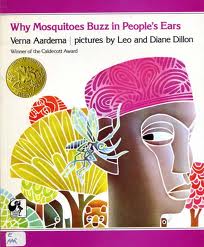
One thing I liked about this story was the opportunity to see Leo & Diane Dillon doing more illustrations. I came across their work while reading Why Mosquitoes Buzz in People's Ears and comparing the illustrations of the two books was quite interesting. In The Girl Who Spun Gold the Dillons use metallic paint over painted with gold to emphasize the color. The effect is vivid images that pop off the page!


Book Activity:

The two books, The Girl Who Spun Gold by Virginia Hamilton and Tom Tit Tot by Evaline Ness, are both adaptations of the original Rumpelstiltskin. I would have students compare and contrast the different versions as an extension activity after reading the books. Students would chart the differences in characters, setting, the event time lines, and endings of the books. A point would be made to cue students into the common elements of the stories as well as the unique perspectives that the authors and illustrators brought to each rendition. Questions to guide the activity would be:
  • What events in the story are common to all three versions? What differences?
  • How did the change in events/characters work to make the story different?
  • In the end did you think the three stories were the same? Why/Why Not?

Tikki Tikki Tembo


Tikki Tikki Tembo
Arlene Mosel & Blair Lent

Synopsis:
Based on an ancient Chinese folktale, the story of Tikki TIkki Tembo explores the origins of short Chinese names. When Tikki’s brother rushes to fetch him help, this one-to-many-syllable name almost costs Tikki his life.

Response:
Although the book does seem to elicit some ethnic stereotypes, it is classic chinese folklore. It’s hard to distinguish between what folklore is acceptable and what is not. For instance Blue Beard is fairy tale that attacks Middle Eastern people. These stories were written hundreds of years ago, and passed along from generation to generation. What is at stake is not the content as much as the tradition that is passed along.

Similar to fairy tales, folk tales are rooted in an oral tradition and passed along. The focus of folk tales specifies the creation of things or habits. The focus of fairy tales is hinged more on the battle between Good and Evil, and tips for living your life.

Although there are some similarities between folk tales and fairy tales, they both draw distinct lines. Folk tales have a communal affect, perhaps this is what makes them live on, the fact that they strive to explain how things came into being.

Activity:
Form book clubs. Have multiple book clubs that discuss Tikki Tikki Tembo and The Girl Who Spun Gold. How has the oral tradition changed? Why? Are these books still relevant today? What is out dated?

Why Mosquitos Buzz in People's Ears

Why Mosquitoes Buzz in people's Ears
by Verma Aardema

Synopsis

Ever wonder why those bothersome mosquitoes won't quit buzzing in your ear? Well this West African folk tale lets us in on why everyone is so angry with those pesky mosquitoes.... One day while drinking from his waterhole, the iguana is visited by the mosquito who tells him a story so outlandish he plugs his ears with sticks to drown out the nonsense. But while the sticks bring peace to the iguana's ears, he doesn't notice the friendly hello of the python snake. Out of confusion the snake runs to hide thinking the iguana is playing a trick on him and in the process sparks an unfortunate series of events that effects all the animals of the forest!

After a horrible accident involving the monkey and a young owlet casts the forest into darkness, an investigation by King Lion is undergone to get to the bottom of the big trouble started by the little mosquito... But will the forest animals live in darkness forever? Will Mother Owl ever bring up the sun? Will the mosquito get what he deserves for starting so much mischief? Why Mosquitoes Buzz in People's Ears gives the answers to all these questions in this fun and animated folk tale.


Response

While reading this story I really enjoyed the illustrations of Leo & Diane Dillon that accompanied the writing of Verma Aardema. The pictures, stenciled water colors, used vibrant colors that brought to life the various animal characters of the story. I found the story to be light and funny, with the exception of the owlet being killed by the monkey, while staying true to the style of typical folk tales.

Similar to Tiki-Tiki Tembo by Arlene Mosel, this story told a tale of how today's behaviors were influenced by a single causal change from the past. In Tiki it was falling into a well that caused everyone to give their children short names, in Mosquitoes it was the commotion in the forest caused by the mosquito that had him buzzing in people's ears ever since, asking, "Zeee! Is everyone still angry with me?" Overall I liked this book's elaborate explanation for such an everyday aggravation and I would definitely think to use it in the classroom!


Book Link Activity

The structure of this book, light story-telling with a clear sense of cause-and-effect, coupled with a lot of different characters would lend itself for use in a Readers' Theatre activity. I think students would really enjoy performing this story. With all the personified animal characters and the funny, drawn out reasoning for why mosquitoes annoyingly buzz around people's ears students would enjoy acting this out in a Readers' Theatre.

The book has eight in-story characters: mosquito, iguana, snake, rabbit, crow, monkey, mother owl, and lion, as well as short declarative sentences that could be broken up to allow for multiple narrators. Students would benefit from increased reading opportunity related to this folk tale that gives a rather funny explanation for such an annoying occurrence!

Another idea is to have students create a Simulated Newspaper telling the events of the story. Students could "interview" characters from the story and write articles or weather forecasts according to the events that took place. It would provide students with a creative alternative to demonstrate their understanding of the book.

There was an Old Lady Who Swallowed a Seashell


There was an Old Lady Who Swallowed a Seashell
Lucille Colandro & Jared Lee

Synopsis:
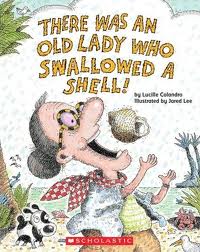
She swallowed a shell, but she wouldn’t tell. Then a whole bunch of stuffed followed. This quirky book will keep you and your class laughing in anticipation to see what goes down this old lady’s gullet next. A beautiful combination of predicability and sequencing make this book engaging and re-readable time and time again.

Response:
These books are fun ways to get your students thinking about literature. Granted, the text is silly and repetitive, but it is also exactly why this text works well. This cause and affect style lends itself to early literacy components as they pertain to plot awareness development and reasoning.

The book finds itself within a cleverly written series of books that bring their wit and charm to all seasons and holidays. Anytime of the year an Old Lady book can be brought out for the youngsters.

Activity:
This book is a great way to introduce cause and affect books. Start with this book and link it with Why Mosquitos Buzz in People’s Ears by letting kids explore the Old Lady books. See if kids can create their own Old Lady book. Once they have done that, see if they can create a similar Mosquito book.

If You Give a Mouse a Cookie

If You Give a Mouse a Cookie

by Laura Joffe Numeroff


Synopsis:

While at home one day a boy discovers a mouse who asks him for a cookie. Seeing no harm in the small demand, the boy grants his request. But as soon as the mouse gets his cookie, he realizes he’ll need a glass of milk to go with it, and how can he be expected to drink his milk without a straw to sip it?! As the story continues, the mouse’s requests get more and more outlandish and wear the boy into the ground. And just as it seems the demands will cease, the boy is in for a rude awakening! For the mouse realizes that he’d like another glass of milk…and if he has a glass of milk he’s going to need a cookie to go with it!

Response:

This story by Laura Joffe Numeroff, with illustrations by Felicia Bond, was another enjoyable read. After thinking about the domino effect of action seen in the last two linked books, If You Give a Mouse a Cookie jumped out at me as the next book to read. After looking through other books in the series, If You Give a Pig a Pancake and If You Give a Moose a Muffin, the original “If You” series book was the book I settled on linking.

This simple story with fun and detailed illustrations is a strong example of cause-and-effect to be shared with young children. Just as in There Was an Old Lady Who Swallowed a Seashell and Why Mosquitoes Buzz in People’s Ears, this story shows how one small action can start a series of events with very unexpected repercussions!

The bossy mouse may give students a reminder of an older sibling or family member, as it did with me, and would allow students an opportunity to see how blindly following the direction of others doesn’t always work out in their favor. Plus the recycled action of the story, though not as clearly presented as in There Was an Old Lady Who Swallowed a Seashell, offers young children a book in which they can follow along and participate.

Activity:

For this book I would incorporate more than one of the “If You” series books to work with students on making predictions about story events, and would have to take place over a few days. I would read one or two of the series books with students, pausing during reading to ask about what the animal character might ask for next. After taking student responses I would continue reading the story to the finish, pointing out how the action is in an infinite loop as the animal character makes the same demands at the end of the book and starts the story all over again.

After reading one or two of the books I would reveal the title of the third story but before reading it have students create their own version of what will happen, using their knowledge of the story structure present in the first two books. After students finished their versions, they could share them with the class and the third book would be read to compare their original stories with Numeroff’s books.

The Little Mouse, the Red Ripe Strawberry and The Big Hungry Bear


The Little Mouse, the Red Ripe Strawberry and The Big Hungry Bear
Don and Audrey Wood

Synopsis:
This gorgeous picture book offers readers a dazzling journey of one mouse and his quest to protect his red, ripe strawberry. Follow the mouse as he hides, protects and eventually shares his tasty morsel.

Response:
Pictures are the main focus with this book. The large illustrations are accompanied by minimal text. Beginning readers can catch many cues from these beautiful pictures. And, don’t think just because there is minimal text that there aren’t big words for younger readers to decode.

We once again find a mouse in a predicament. The mouse seems to be a very popular charcter to be the underdog in some literature. It can a symbol of cunning wit, or helplessness, or occasionally mischief. In this instance the mouse is a mischievous underdog, albeit, hungry.

Activity:
Using both this text If you Give a Mouse a Pancake, and various other mouse character texts, have the kids analyze the different ways mice are portrayed in literature. Once they have analyzed the mouse, they can move onto another character.